

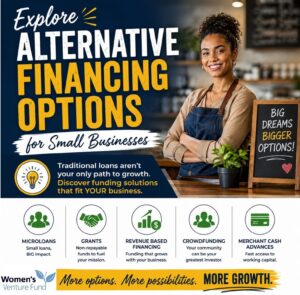
 For many small business owners, securing capital can be one of the biggest challenges of starting, operating, or expanding a company. Traditional bank loans remain an important source of funding, but they are not the only option. Depending on a business’s cash flow, credit history, growth plans, and financing needs, alternative funding can provide another path to capital.
Alternative financing includes a wide range of options from SBA-backed microloans and online lending to crowdfunding, invoice financing, revenue-based financing, and equity investment. The key is understanding how each option works, what it costs, and which risks it may create.
Why Consider Alternative Financing?
A traditional bank loan can be attractive because it may offer relatively competitive interest rates and predictable repayment terms. However, qualifying can be difficult for newer businesses or companies with limited credit history, inconsistent revenue, or insufficient collateral.
Alternative lenders and financing models may offer greater flexibility. The U.S. Small Business Administration notes that alternative lending can provide a faster application process and different qualification requirements than traditional bank financing, although alternative lenders can also charge higher rates.
Before pursuing any type of financing, business owners should determine how much capital they actually need, what the money will be used for, and how quickly they can repay it. SCORE recommends considering factors such as credit scores, revenue, financing purpose, and repayment timeline when comparing funding options.
1. SBA Microloans
SBA Microloans can be particularly useful for startups and small businesses that need a relatively modest amount of capital. The program provides loans of up to $50,000 through participating nonprofit intermediary lenders.
According to the SBA, the average microloan is around $13,000, making the program potentially useful for expenses such as working capital, inventory, supplies, equipment, or other smaller business needs.
Potential advantages:
- Smaller loan amounts can be appropriate for early-stage businesses such as WVF Loans.
- Fixed interest rates can make repayment more predictable.
- The program is designed specifically to support small businesses.
Potential drawbacks:
- Funding limits may not be sufficient for major expansion.
- Borrowers still have to meet lender requirements.
- Interest and fees increase the overall cost of the financing.
Research further: SBA Microloan information
2. Online Business Loans
Online lenders have created another alternative to conventional bank financing. Applications are often completed digitally, and lenders may consider business cash flow and other data when evaluating applicants.
The convenience can be valuable when a company needs working capital relatively quickly. However, speed and accessibility can come at a higher cost than traditional financing. Business owners should compare the annual percentage rate, fees, repayment frequency, total repayment amount, and any prepayment penalties before signing an agreement.
SCORE identifies online business loans as one of the alternatives available to businesses that may not fit traditional bank lending criteria.
Best suited for: Businesses with established revenue that need relatively quick access to working capital.
3. Invoice Financing and Factoring
Businesses that invoice customers may experience a frustrating gap between completing a job and receiving payment. Invoice financing can help convert those unpaid invoices into cash sooner.
With factoring, for example, a business sells eligible invoices to a factoring company at a discount. The business receives cash before its customers pay, while the factor collects the invoices.
This can be especially useful for companies that have reliable customers but long payment terms.
Advantages:
- Provides working capital without waiting for customers to pay.
- Financing decisions may focus heavily on the quality of the business’s receivables.
- Can help businesses manage cash-flow gaps.
Considerations:
- Fees reduce the amount ultimately received.
- Customers may interact with the factoring company.
- The contract may include additional obligations or costs.
Research further: SCORE’s guide to factoring
4. Crowdfunding
Crowdfunding allows a business to raise money from a large number of individuals through an online platform. Different models exist, including reward-based, equity-based, and debt-related crowdfunding.
For example, a company developing a new consumer product might offer supporters an early version of the product or another reward. Equity crowdfunding can instead involve selling an ownership interest in the company.
The SBA recommends carefully reviewing the terms of any crowdfunding platform because the financial and legal obligations vary depending on the model.
Crowdfunding may be particularly attractive when:
- A company has a compelling product or story.
- The business already has an engaged customer community.
- Traditional financing is difficult to obtain.
- The owner wants to test market interest while raising capital.
However, a crowdfunding campaign requires marketing, preparation, and transparency. Raising money is not guaranteed.
5. Revenue-Based Financing
Revenue-based financing provides capital in exchange for repayments that are tied to future business revenue. Rather than making a conventional fixed loan payment, a business may repay a percentage of its revenue until it reaches an agreed repayment amount.
This structure can be appealing to businesses with fluctuating monthly revenue because payments may move with sales. However, the total cost and effective financing rate need to be examined carefully.
Revenue-based financing is one of several alternative financing models discussed in SCORE’s current funding resources.
6. Business Lines of Credit
A business line of credit can provide more flexibility than receiving one large lump-sum loan. Once approved, the business can draw funds as needed, repay them, and potentially access available credit again.
This can make a line of credit useful for seasonal businesses or companies dealing with recurring short-term cash-flow needs.
For example, a contractor might use a line of credit to purchase materials before receiving payment from a customer.
The important question is whether the cost of maintaining and using the line of credit is justified by the flexibility it provides.
7. Equipment Financing
If the primary need is purchasing machinery, vehicles, computers, or other business equipment, equipment financing may be more appropriate than taking a general-purpose loan.
The equipment itself may help secure the financing, potentially reducing the need for other collateral. The financing term can also be structured around the useful life of the asset.
Business owners should compare the total financing cost with the expected revenue or savings the equipment will generate.
8. Grants and Community Development Financial Institutions
Grants are an attractive source of capital because they generally do not have to be repaid. However, they can be competitive and may have strict eligibility requirements.
Community Development Financial Institutions (CDFIs) are another potential resource. They provide financing and financial services to communities and businesses that may have difficulty accessing conventional financial institutions.
SCORE’s current financing resources specifically identify CDFIs, microloans, and other alternative lenders as options worth exploring when a business does not qualify for traditional financing.
9. Equity Financing and Angel Investors
Instead of borrowing money, a business can raise capital by selling an ownership interest. Angel investors and other private investors may provide funding in exchange for equity.
The major advantage is that equity financing does not require traditional loan payments. The trade-off is that owners give up some ownership and potentially some control over the business.
This approach may be more appropriate for companies with significant growth potential than for a small business seeking short-term working capital.
SCORE recommends comparing bootstrapping, debt, and equity based on the owner’s goals, desired control, and tolerance for risk.
How to Choose the Right Financing Option
There is no single financing option that works for every small business. A useful starting point is to answer five questions:
- How much money do I need?
- What exactly will the money pay for?
- How quickly do I need the funds?
- How much can my business comfortably afford to repay?
- Am I willing to give up equity or control in exchange for capital?
For example, a business waiting 60 days for customer payments may benefit from invoice financing, while a company purchasing a new piece of machinery may be better served by equipment financing. A startup with a strong consumer product might explore crowdfunding or equity investment.
Compare the Total Cost—not Just the Interest Rate
One of the most important mistakes a business owner can make is comparing financing solely by its advertised interest rate.
Before accepting an offer, calculate:
- Interest or factor charges
- Origination and application fees
- Monthly or weekly payments
- Total amount that will be repaid
- Collateral requirements
- Personal guarantees
- Prepayment penalties
- Late-payment fees
- Whether payments fluctuate with revenue
- The consequences of default
A financing product with faster approval is not necessarily a better deal if its total cost puts excessive pressure on the company’s cash flow.
Build a Financing Strategy Before You Need the Money
The strongest financing decision is often made before a cash-flow crisis occurs. SCORE recommends planning ahead and evaluating financing based on the purpose of the money, the amount required, and the business’s ability to repay.
Business owners should maintain current financial statements, cash-flow projections, tax records, and business credit information. Having these documents ready can make it easier to compare offers and demonstrate financial stability to lenders or investors.
It can also make sense to combine different forms of financing strategically. SCORE’s recent discussion of the “capital stack” describes how businesses can use different funding sources for different purposes—for example, short-term working capital for cash-flow needs and longer-term financing for equipment or expansion.
Final Thoughts
Alternative financing gives small businesses more choices than simply asking a traditional bank for a loan. SBA microloans, online lending, invoice financing, crowdfunding, revenue-based financing, business lines of credit, grants, CDFIs, equipment financing, and equity investment can each serve different business needs.
The best option is not necessarily the one that provides money the fastest. It is the option whose cost, repayment structure, eligibility requirements, and risk match the business’s financial position and goals.
Before making a financing decision, business owners should research multiple providers, read the complete financing agreement, calculate the total cost of capital, and consider consulting a qualified financial professional or small-business mentor.
Resources To Further Your Research
- U.S. Small Business Administration — Funding Your Business
- SBA Microloan Program
- WVF — Funding Options for Your Business
This article is for general educational purposes and is not financial, legal, or tax advice. Financing terms, eligibility requirements, and regulations can vary by lender and change over time.